

Sustainability · 2025
In this section49 topics
- Sustainability Policy2 items
- Sustainability Goals & UN SDGs3 items
- Policy Review2 items
- Business Value Chain1 item
- Stakeholder Analysis2 items
- Environmental Policy & Guidelines4 items
- Environmental Policy Review1 item
- Energy — Plan & Guidelines1 item
- Energy — Electricity Consumption1 item
- Energy — Fuel Consumption1 item
- Energy — Targets1 item
- Energy — Performance & Outcomes2 items
- Water — Plan & Guidelines1 item
- Water — Withdrawal, Discharge & Consumption1 item
- Water — Targets1 item
- Water — Performance & Outcomes2 items
- Waste — Plan & Guidelines1 item
- Waste — Generation, Disposal & Recycling1 item
- Waste — Targets1 item
- Waste — Performance & Outcomes2 items
- GHG — Plan & Guidelines2 items
- GHG — Emissions1 item
- GHG — Emissions Verification1 item
- GHG — Principles & Standards1 item
- GHG — Targets1 item
- GHG — Performance & Outcomes2 items
- Environmental Legal Incidents1 item
- Social Sustainability — Overview1 item
- Social Policy & Guidelines3 items
- Social Policy Review1 item
- Social — Principles & Standards Practised1 item
- Human Rights Due Diligence1 item
- Employees — Plan & Guidelines3 items
- Employees — Workforce1 item
- Employees — Remuneration & Provident Fund1 item
- Employees — Training & Development2 items
- Employees — Occupational Health & Safety1 item
- Employees — Labour Relations1 item
- Employees — Employee Representation1 item
- Employees — Targets1 item
- Employees — Performance & Outcomes1 item
- Customers — Plan & Guidelines3 items
- Customers — Satisfaction Results1 item
- Customers — Targets1 item
- Customers — Performance & Outcomes1 item
- Community & Social — Plan & Guidelines3 items
- Community & Social — Targets1 item
- Community & Social — Performance & Outcomes1 item
- Law Violation Incidents2 items
Sustainability Policy
Has a Sustainability Policy
Yes
Policy Description
The Group of Companies focuses on and develops to be a leader in comprehensive and specialized energy management, including the sustainable provision of efficient and environmentally friendly alternative energy sources. Furthermore, it is committed to being a good role model for renewable energy in Thailand by building credibility for investors and stakeholders in business operations, increasing value, and promoting the sustainable growth of the organization, as well as managing according to universal good governance principles and benefiting Thai society. All of this is to achieve its goals and maintain excellence in ethics, which are the fundamental values of a leading organization.
Sustainability Goals & UN SDGs
Has Sustainability Goals
Yes
Goals Description
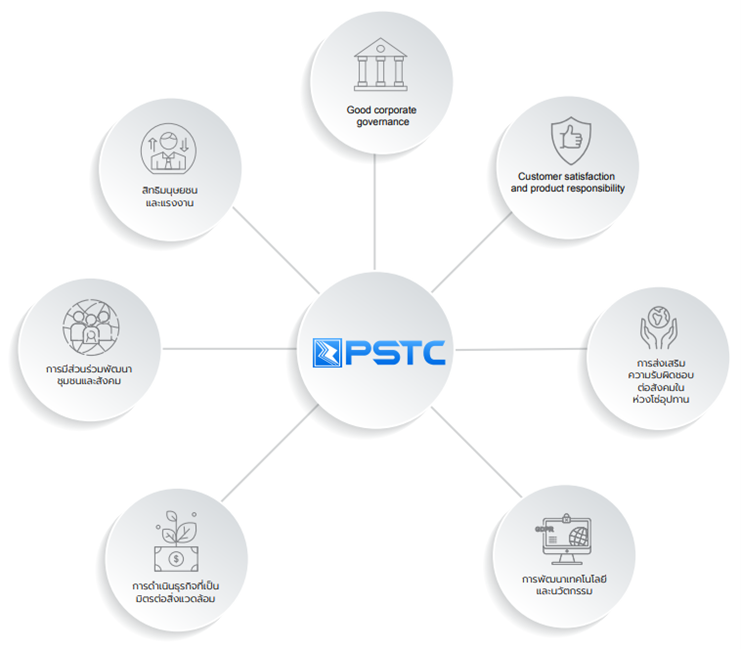
The company has established policies and sustainability management goals comprising 7 main topics to cover the three dimensions of sustainability: economic, environmental, and social. This is done by considering the group of companies' current business operations, new businesses, risks, and global sustainability trends, with the following practices:
1. Good Corporate Governance.
2. Ensuring customer satisfaction and product responsibility.
3. Promoting social responsibility in the supply chain.
4. Technology and Innovation Development.
5. Environmentally Friendly Business Operations.
6. Community and Social Development Participation.
7. Human Rights and Labor.
-
Good Corporate Governance. Operating under good corporate governance policies, organizational ethics, and other related policies. Complying with laws, regulations, and resisting all forms of corruption.
-
Ensuring customer satisfaction and product responsibility. Committed to providing professional service with standardized and efficient work systems, understanding customer needs to achieve maximum customer satisfaction, building long-term trust in services for customers, as well as adhering to customer ethics and strictly maintaining business confidentiality.
-
Promoting social responsibility in the supply chain. Implementing transparent and auditable procurement processes. Jointly assessing and managing operational risks, with an emphasis on building and fostering relationships with trading partners and business allies to enhance business potential.
-
Technology and Innovation Development. Studying and developing operations in terms of product development, technology, and innovation that align with the group of companies' business operations, as well as continuously developing personnel with knowledge and expertise.
-
Environmentally Friendly Business Operations. Selecting investments and developing environmentally friendly projects that utilize clean technology. Implementing systematic environmental management according to standards. Instilling and fostering environmental conservation awareness and efficient resource utilization among employees and stakeholders, as well as supporting and participating in driving efforts to reduce environmental impacts.
-
Community and social development participation. Creating social value, promoting participation in surrounding community development through investment in social projects, and creating shared spaces for sustainable community benefits.
-
Human Rights and Labor. Respecting and protecting fundamental human rights, equality, fairness, and not being involved in human rights abuses. This includes monitoring and evaluating business partners to ensure they are not at risk of human rights violations and treating employees equally.
Furthermore, the company has a sustainability strategy that aligns with its Sustainability Policy and responds to the United Nations Sustainable Development Goals. The company's response to the Sustainable Development Goals, based on its key operational results in 2025, can be summarized as follows:
|
Key sustainability issues of the company. |
Key Operational Results. |
Alignment with Sustainable Development Goals. |
|
Organizations that operate to ensure good well-being. 3.6 Reduce the number of deaths and injuries from road traffic accidents. |
The group of companies' business operations involve manufacturing, services, transportation, and travel, and may impact the safety and health of employees, business partners, communities, and stakeholders. Therefore, the group places importance on safe work behavior and culture to support the assurance of good health. |
|
|
Product-conscious organizations. 8.3 Promote policies that focus on creative and innovative development. Organizations that promote sustained, inclusive, and sustainable economic growth, decent employment, and good work for all. 8.5 Promote full and productive employment and decent work for all women and men, including fair wages. 8.8 Protect labor rights and promote safe and secure working environments for all workers, including migrant workers. |
The group of companies prioritizes international quality management to achieve maximum customer satisfaction, focusing on the quality and standards of products, as well as developing new services to offer to customers. The group of companies is committed to fair human resource management in terms of compensation and benefits, prioritizing workplace safety, promoting training to enhance knowledge and skills for career advancement, and fostering employee engagement with the organization. |
|
|
Organizations that conduct business equitably, reduce inequality, and are non-discriminatory. 10.3 Ensure equal opportunity for all and reduce inequalities. |
The group of companies emphasizes respecting and protecting fundamental human rights, equality, fairness, and not being involved in corruption or human rights abuses, treating employees equally, and promoting employee participation in social activities both within and outside the organization. |
|
|
Organizations with social and environmental responsibility. 12.2 Sustainable management and efficient use of natural resources. 12.5 Substantially reduce waste generation through prevention, reduction, recycling, and reuse. |
The group of companies has encouraged executives and employees at all levels to conserve natural resources and energy, supported the recycling of materials, and placed great importance on maximizing the value of raw materials and waste by reusing them in various production processes. Employees are required to be attentive and perform their duties with a consciousness of safety and environmental considerations, and employees are trained on environmental matters. |
|
|
Organizations taking urgent action to combat climate change and its impacts. 13.1 Strengthen resilience and adaptive capacity to climate-related hazards and natural disasters in all countries. 13.2 Integrate climate change measures into national policies, strategies, and planning. 13.3 Improve education, awareness-raising, and human and institutional capacity on climate change mitigation, adaptation, impact reduction, and early warning. |
The group of companies is committed to accelerating adaptation and operations in various dimensions to reduce greenhouse gas emissions, as well as fostering cooperation to adapt to and cope with climate change and its potential impacts. |
|
|
Accountable and transparent organizations. 16.5 Reduce corruption and bribery in all their forms. 16.6 Develop effective, accountable, and transparent institutions at all levels. |
The group of companies is aware of and committed to combating corruption both within and outside the organization. The company adheres to conducting business with transparency, fairness, and accountability in every process and stage of work. In 2024, the company joined the Private Sector Collective Action Coalition Against Corruption (CAC) and has been certified as a member since 2018, receiving its second continuous renewal of certification. |
|



UN Sustainable Development Goals
| SDG Goal |
|---|
| Goal 3 Good Health and Well-being |
| Goal 8 Decent Work and Economic Growth |
| Goal 10 Reduce Inequalities |
| Goal 10 Reduce Inequalities |
| Goal 10 Reduce Inequalities |
| Goal 12 Responsible Consumption and Production |
| Goal 12 Responsible Consumption and Production |
| Goal 12 Responsible Consumption and Production |
| Goal 13 Climate Action |
| Goal 13 Climate Action |
| Goal 13 Climate Action |
| Goal 16 Peace, Justice and Strong Institutions |
| Goal 16 Peace, Justice and Strong Institutions |
| Goal 16 Peace, Justice and Strong Institutions |
Policy Review
Policy Reviewed This Year
Yes
Policy Changed This Year
No
Business Value Chain
Value Chain Description
The group has a policy to promote and support business operations under good corporate governance and ethical principles, along with caring for the environment and society. It has a genuine sense of social responsibility by considering the stakeholders involved both inside and outside the organization, from shareholders, employees, customers, communities, and society in line with the Sustainable Development Goals framework. To achieve sustainable development goals and create shared value for society, as well as build trust and confidence among stakeholders in all dimensions.
Value Chain of the Liquefied Petroleum Gas Business BIGGAS Technology Co., Ltd. ("BIGGAS"), as a subsidiary of the group, has criteria for the ethical assessment, selection, and inspection of business partners. It is based on the business stability and reliability of the partners, including social and environmental responsibility. The gas distribution business is divided into 2 businesses as follows:
• Liquefied Petroleum Gas (LPG) Business BIGGAS, licensed as a fuel trader under Section 10 of the Fuel Trade Act B.E. 2543 (2000) for liquefied petroleum gas, distributes under the trademark "BIGGAS" to customer groups covering all 3 sectors: industrial, automotive, household, and commercial. BIGGAS has efficient management from the procurement of LPG from partner refineries, which will be transported by sea to the gas depot in Bang Pakong District, Chachoengsao Province. Afterward, it will be delivered by LPG trucks to various customer groups such as industrial factories, LPG stations, and BIGGAS gas filling plants.
• Liquefied Natural Gas (LNG) Business BIGGAS signed a contract to be a distributor of liquefied natural gas or LNG with PTT in March 2018 to market to industrial factory customers nationwide, especially factories located outside the natural gas pipeline. BIGGAS will receive LNG from PTT's storage terminal in Map Ta Phut, Rayong Province, and will deliver it by truck to customers' factories. BIGGAS will invest in installing LNG storage stations and vaporization equipment at the end-user's factories. LNG is an alternative fuel that can be used to replace LPG and fuel oil, helping to reduce production costs. It is also a clean fuel that burns completely, helping to reduce CO2, PM2.5 dust, and pollution from conventional fuels.
Currently, the group's main businesses are the liquefied petroleum gas business and the liquefied natural gas business, which are the company's primary sources of revenue. However, in the future, the company is committed to disclosing the value chains of other businesses within the group in due course.
Stakeholder Analysis
Introduction
The Company divides its customers into 3 main groups:
1) Industrial group: Industrial factories that require fuel to produce steam or heat used in production.
2) Service station group: Service stations that sell LPG to motorists who use LPG vehicles.
3) Gas station and commercial group: Selling LPG cylinders through a network of gas stations, taking into account the following main criteria:
• Quality Providing gas as a clean fuel with high combustion efficiency and high heat, resulting in reduced energy costs.
• Safety Liquefied natural gas, or LNG, has many outstanding safety features. For example, it is a gas that is lighter than air. If a leak occurs, it will float into the atmosphere. It is also a gas with a higher ignition temperature than other similar fuels.
• Social and/or environmental Fuel gas is a clean energy source compared to other fossil fuels. It has complete combustion efficiency, resulting in less pollution such as CO2, SOx, PM 2.5, or other pollutants caused by combustion, which has less impact on the environment and society.
In addition, each stakeholder group affected by the Company's operations participates in determining the materiality that stakeholders in each group have different expectations from the Group, as follows:
Stakeholder Analysis
| Stakeholder Type | Stakeholders | Stakeholder Expectations | Response to Expectations | Communication Activities |
|---|---|---|---|---|
| External stakeholders | 2904 · Description: Investors or investment institutions · 2913 · Description: Shareholders | 1. Operating results with growing performance
Net profit attributable to shareholders
2. Business direction and growth
3. Providing information to all shareholders/investors equally | 1. Information disclosure through various channels.
2. Communicating performance/results to investors.
3. Compliance with the regulations and guidelines of the Stock Exchange of Thailand and the Securities and Exchange Commission.
4. Providing diverse channels for information disclosure and communication with shareholders and investors.
5. Ensuring accurate, complete, and compliant information disclosure in accordance with the regulations of the Stock Exchange of Thailand and the Securities and Exchange Commission.
6. Serving as an additional channel to enhance convenience for shareholders/investors in accessing information for investment decisions. | 2938 · Description: Visit · 2941 · Description: Online Communication · 2944 · Description: Annual General Meeting (AGM) · 2949 · Other name: Press Release · Description: Others |
| External stakeholders | 2923 · Description: Customers | 1. Products meet quality and standards and are delivered on time.
2. Continuous development of service channels to be efficient, fast, and meet problems and needs.
3. Having measures to maintain the security of customers' personal information and not violating customers' personal information. | 1. Product development and delivery that meets customer needs.
2. Continuous development and improvement of customer service systems and channels to ensure service efficiency and prompt problem resolution, utilizing customer satisfaction data and feedback.
3. Strict adherence to the organization's policy on personal data protection, ensuring that all processing of personal data is conducted with caution, diligence, and in accordance with established procedures. Processing of personal data is limited to what is necessary for operational purposes. | 2941 · Description: Online Communication · 2948 · Description: Training / Seminar · 2949 · Other name: Customer visit · Description: Others · 2949 · Other name: Various media types · Description: Others |
| External stakeholders | 2899 · Description: Suppliers | 1. Transparent and Fair Procurement
2. Fast and Transparent Procurement Process
3. On-Time Payment for Goods/Services | 1. Adhering to procurement policies that are documented, easy to understand, and consistently applied.
2. Establishing and publicly disclosing vendor qualification criteria, ensuring that accurate and complete procurement information and conditions are accessible to eligible bidders in a transparent and equitable manner.
3. Implementing transparent and fair work acceptance procedures and ensuring timely payment for goods or services. | 2938 · Description: Visit · 2941 · Description: Online Communication · 2949 · Other name: Collaboration within the organization and with partners · Description: Others |
| Internal stakeholders | 2921 · Description: Employees | 1. Career Advancement
2. Skills Development Training
3. Occupational Health and Safety
4. Effective and Fair Performance Evaluation System | 1. Communicate company performance to employees at all levels.
2. Promote career advancement for employees by developing effective performance evaluations.
3. Encourage the development of employee potential, skills, and knowledge through learning channels appropriate to employee behavior and with a variety of learning topics. | 2942 · Description: Internal Meeting · 2948 · Description: Training / Seminar · 2949 · Other name: Company Outing · Description: Others |
Environmental Policy & Guidelines
Introduction
The company has recognized the potential environmental impact of its operations and has therefore implemented measures to prevent pollution problems arising from its activities. Currently, the company does not release waste that adversely affects the environment, nor is it involved in any environmental disputes.
Has an Environmental Policy
Yes
Policy Description
Environmentally friendly business operations
The Group prioritizes operating with environmental responsibility and focuses on the efficient and sustainable use of resources throughout its business processes. This includes overseeing operations to comply with environmental governance principles and strictly adhering to relevant environmental laws. The Group considers and selects investments, and develops environmentally friendly power plant projects that utilize clean technology. Environmental management is systematically implemented according to established standards. Furthermore, the Group fosters and raises awareness among employees and stakeholders regarding environmental conservation and the efficient use of resources, while also supporting and actively participating in initiatives to reduce environmental impact.
Environmental Guidelines
| Guideline |
|---|
| Electricity Management |
| Renewable/Clean Energy Management |
| Water Management |
| Greenhouse Gas and Climate Change Management |
Environmental Policy Review
Policy Reviewed This Year
No
Energy — Plan & Guidelines
Has an Energy Management Plan
No
Energy — Electricity Consumption
Electricity Consumption
| Metric | Current Year | Previous Year | Two Years Ago |
|---|---|---|---|
| Total electricity consumption within the organization (Kilowatt-Hours) | 42,545.9 | 0 | 0 |
| Electricity purchased for consumption from non-renewable energy sources (Kilowatt-Hours) | |||
| Electricity purchased or generated for consumption from renewable energy sources (Kilowatt-Hours) |
Energy — Fuel Consumption
Fuel Consumption
| Metric |
|---|
| Crude oil (Barrels) |
| Coal (Metric tonnes) |
| Jet fuel (Litres) |
| Diesel (Litres) |
| Gasoline (Litres) |
| Fuel oil (Litres) |
| Natural gas (Standard cubic feet) |
| LPG (Kilograms) |
| Steam (Metric tonnes) |
Energy — Targets
Has Set Targets
No
Energy — Performance & Outcomes
Has Performance Results
No
Performance Description
Efficient Energy Use
The group of companies prioritizes energy management and climate change to prevent adverse impacts on communities and the environment, and to help reduce energy costs. Stakeholders also attach importance to climate change and global warming issues caused by greenhouse gas emissions. In the past year, the company has managed electricity and lighting.
With a strict policy to control electricity consumption within the office to reduce unnecessary energy use, as follows:
-
Time Control
Lighting is switched on at 08:30 AM (start of working hours) and turned off during lunch breaks and after working hours. In addition to clearly defined central lighting schedules, the company also encourages all employees to participate in Turn off unnecessary or unused lights immediately. to foster individual energy-saving discipline and reduce the wasteful loss of electrical resources throughout the day.
-
Renewable Energy:
Solar rooftop panels have been installed in the office building to utilize clean energy within the organization, reducing reliance on central electricity and lowering greenhouse gas emissions.
-
Energy Saving Campaign
Encourage employees to use stairs instead of elevators when moving between nearby floors to reduce electricity consumption and promote good health among personnel.
Water — Plan & Guidelines
Has a Water Management Plan
No
Water — Withdrawal, Discharge & Consumption
Water Withdrawal, Discharge & Consumption
| Metric | Current Year | Previous Year | Two Years Ago |
|---|---|---|---|
| Total water withdrawal (Cubic meters) | 1,832 | 0 | 0 |
| Total water withdrawal by third-party water (Cubic meters) | |||
| Total water withdrawal by surface water (Cubic meters) | |||
| Total water withdrawal by groundwater (Cubic meters) | |||
| Total water withdrawal by seawater (Cubic meters) | |||
| Total water withdrawal by produced water (Cubic meters) | |||
| Percentage of wastewater treated before discharge (%) | |||
| Total water discharge (Cubic meters) | |||
| Total water discharge to third-party water (Cubic meters) | |||
| Total water discharge to surface water (Cubic meters) | |||
| Total water discharge to groundwater (Cubic meters) | |||
| Total water discharge to seawater (Cubic meters) | |||
| Total water consumption (Cubic meters) | 1,832 | 0 | 0 |
| Recycled water (Cubic meters) |
Water — Targets
Has Set Targets
No
Water — Performance & Outcomes
Has Performance Results
No
Performance Description
Efficient Water Utilization
The company recognizes the importance of water resources, which are limited natural resources. Therefore, it focuses on maximizing the beneficial use of water resources within the organization and minimizing unnecessary wastage through the following key measures:
Adopting Innovation
The company has installed an "automatic sensor faucet system" in common areas and employee restrooms to control water flow to an appropriate level for actual use. This helps prevent issues such as leaving taps running or not fully closing water valves, which are primary causes of unnecessary water wastage. Waste Reduction and Cost Savings
This proactive technological measure not only significantly reduces the organization's water consumption but also helps reduce utility expenses and reflects the company's commitment to conducting business responsibly towards natural resources.
Raising Awareness
The company promotes and cultivates awareness among employees regarding the judicious use of water, while also regularly arranging for inspections of the building's plumbing system to prevent potential leaks.
Waste — Plan & Guidelines
Has a Waste Management Plan
No
Waste — Generation, Disposal & Recycling
Waste Generation, Disposal & Recycling
| Metric |
|---|
| Total waste generated (Kilograms) |
| Non-hazardous waste (Kilograms) |
| Non-hazardous waste - Landfilling (Kilograms) |
| Non-hazardous waste - Incineration (with energy recovery) (Kilograms) |
| Non-hazardous waste - Incineration (without energy recovery) (Kilograms) |
| Non-hazardous waste - Other disposal operations (Kilograms) |
| Hazardous waste (Kilograms) |
| Hazardous waste - Landfilling (Kilograms) |
| Hazardous waste - Incineration (with energy recovery) (Kilograms) |
| Hazardous waste - Incineration (without energy recovery) (Kilograms) |
| Hazardous waste - Other disposal operations (Kilograms) |
| Total reused/recycled waste (Kilograms) |
| Reused/Recycled non-hazardous waste (Kilograms) |
| Reused non-hazardous waste (Kilograms) |
| Recycled non-hazardous waste (Kilograms) |
| Reused/Recycled hazardous waste (Kilograms) |
| Reused hazardous waste (Kilograms) |
| Recycled hazardous waste (Kilograms) |
Waste — Targets
Has Set Targets
No
Waste — Performance & Outcomes
Has Performance Results
No
Performance Description
Waste and Residual Material Management
The company is committed to minimizing waste from its operations (Waste to Zero) by applying the principles of the Circular Economy to manage resources for maximum value, as follows:
-
Reduction at the Source (Reduce): Promote employees to reduce the use of single-use plastics within the office area and encourage the use of personal water bottles or containers to reduce the amount of non-biodegradable waste.
-
Reusing (Reuse): In addition to promoting the use of double-sided paper (Reuse Paper) to conserve forest resources and reduce costs, the company also supports the reuse of other office materials for maximum benefit before disposal.
-
Systematic Waste Segregation (Recycle): Clearly designated waste bins are provided within the building to separate recyclable waste (e.g., plastic bottles, aluminum cans) from general waste, ensuring proper processing and reducing the burden on municipal waste disposal.
-
Hazardous Waste Disposal: There is a system for collecting and separating hazardous waste, such as batteries or electronic equipment (E-Waste).
appropriately, to prevent toxic substances from contaminating the environment, and coordinates with specialized agencies for proper disposal.
Such operations not only help reduce accumulated waste and greenhouse gas emissions contributing to global warming but also instill awareness among company personnel to value every resource and collectively build a tangible Low Carbon Society.
GHG — Plan & Guidelines
Has a GHG Management Plan
Yes
Plan Description
The group of companies recognizes the importance of participating in maintaining a good quality society and environment and undertakes various activities to promote and support sustainable social and environmental development. Considering Thailand's greenhouse gas emissions, the energy sector accounts for the largest proportion, followed by the agricultural sector, industrial sector, product use, and waste sector, respectively.
Operations
1. Support employees and the company with knowledge regarding environmental considerations, by setting a target of Net Zero Emissions.
2. Environmental Aspect: Fuel gas is a clean energy source compared to other fossil fuels, with complete combustion efficiency, leading to pollutants such as CO 2 , SO x , PM 2.5, or other pollutants resulting from combustion are minimal, leading to less impact on the environment and society.
3. Quality Aspect: The company will procure clean fuel gas with high combustion efficiency and high heat output, which will lead to reduced energy costs.
Greenhouse Gas Emission Management The company aims to develop its business towards a low-carbon society, with operational results as follows:
1. Use energy economically and with maximum efficiency.
2. Operate in accordance with environmental laws / regulations
3. Prepare the Carbon Footprint of Organization (CFO)
Goals, Guidelines, and Strategies to Reduce Greenhouse Gas Emissions from Business Operations
The company operates in electricity and energy production, thus directly utilizing fuel for production. The company therefore focuses primarily on reducing direct greenhouse gas emissions by identifying opportunities and potential for greenhouse gas reduction through improving energy efficiency, minimizing production losses, studying the use of alternative fuels to achieve greenhouse gas reduction targets, and seeking investment opportunities in renewable energy businesses.
Goals Although the company's renewable energy electricity generation contributes to improving the overall global environment and atmosphere, there are still minor greenhouse gas emissions during the production process. Therefore, to demonstrate its commitment to its vision and mission of conducting business for the utmost benefit of society, stakeholders, and the environment, the company has set a goal to become a Net Zero Emissions organization by systematically integrating various measures as follows:
Carbon Reduction Measures (Carbon Lower) such as reducing or refraining from unnecessary activities, using cleaner production and waste management technologies, increasing solar energy utilization, etc.
Carbon offset measures such as carbon capture/storage technologies, carbon purchasing, etc.
Operational Guidelines and Strategies Prepare the Carbon Footprint of Organization (CFO) to collect data on activities that generate greenhouse gases, which will be used for planning and managing the efficient and concrete reduction or offsetting of greenhouse gas emissions.
Energy Conservation The company promotes energy conservation in the office, such as setting schedules for turning lights and air conditioners on and off, switching to automatic on-off electrical devices or light sensor LEDs, and selecting products with Energy Label No. 5.
Personnel Development Provide training to employees on global warming to raise awareness for reducing greenhouse gas emissions from daily activities and work.
Database System Establishment Development of a detailed and accurate data collection system for electricity, fuel, and other resource consumption, to serve as a crucial database for calculating the carbon footprint in the subsequent year.
Operate in accordance with environmental laws / regulations All of the company's renewable energy power plants strictly adhere to the measures specified in the EIA/CoP reports, both during the pre-operation, construction, and operation phases. Throughout the operational period, compliance reports (EIA Monitoring Report or CoP Monitoring Report) have been submitted to relevant agencies for annual inspection. All power plants are able to control environmental quality and pollution, both within the power plants and in the surrounding communities, to 100% standard levels. The results of environmental quality and pollution parameter measurements in all aspects comply with all specified laws and standards*, thus not creating negative impacts on natural resources and the environment.
Following the completion of the organizational greenhouse gas inventory (Carbon Footprint of Organization: CFO) in 2024, the company will utilize 2025 as a crucial period to thoroughly analyze and evaluate the results from this database. This will be used to establish a baseline and develop a more efficient and accurate internal data collection system, thereby preparing for the concrete implementation of greenhouse gas reduction measures aligned with the long-term Net Zero target.
GHG — Emissions
GHG Emissions
| Metric | Previous Year |
|---|---|
| Total GHG emissions (Metric tonnes of carbon dioxide equivalent) | 193 |
| Total greenhouse gas emissions 1 (Metric tonnes of carbon dioxide equivalent) | 145 |
| Total greenhouse gas emissions 2 (Metric tonnes of carbon dioxide equivalent) | 25 |
| Total greenhouse gas emissions 3 (Metric tonnes of carbon dioxide equivalent) | 23 |
GHG — Emissions Verification
Emissions Verified by a Third Party
No
GHG — Principles & Standards
Principles & Standards Applied
| Standard |
|---|
| 2671 |
GHG — Targets
Has Set GHG Targets
No
GHG — Performance & Outcomes
Has Performance Results
Yes
Performance Description
Over the past two decades, the group of companies has remained committed to sustainable development in the environmental dimension, integrating goals to reduce natural resource consumption, decrease greenhouse gas emissions, mitigate environmental impacts, and promote a circular economy throughout the value chain of product and service development, in order to enhance the quality of life and environment for everyone.
In 2025, the company concretely laid the foundation for environmental management, with the following significant results:
1. Success from the Use of Energy-Saving Technology
-
Smart Lighting System Installation: The company has fully installed LED lights and a Light Sensor system as planned in common areas and main offices, resulting in more precise control over electricity consumption and reduced energy waste from lights being left on during periods of non-use.
-
Building Heat Management: The selection of energy-saving materials in newly renovated areas helps reduce the workload of the air conditioning system, allowing for more stable and efficient temperature maintenance within the building.
2. Building Awareness and Organizational Culture
-
Behavioral Change: Employees continuously cooperate in reducing resource consumption, such as reducing paper usage (Paperless) and properly sorting waste, leading to a decreasing trend in waste to landfill compared to the previous year.
-
Personnel Readiness: Personnel in relevant departments have been communicated with and understand greenhouse gas management guidelines, making the organization more prepared to drive sustainability policies at a more intensive level.
Environmental Legal Incidents
Legal Violation Incidents
| Metric | Current Year | Previous Year | Two Years Ago |
|---|---|---|---|
| Number of cases or incidents of legal violations or negative environmental impact (cases) | 0 | 0 | 0 |
Employees — Plan & Guidelines
Has an Employee Management Plan
Yes
Plan Description
Human Resource Management Employees are considered a vital resource for the company and its business operations. Promoting skilled labor quality will benefit both employees and the company in developing potential and growth to achieve shared success. Therefore, the company has always treated employees fairly, adhering to principles of good governance and ethics, and managing operations with transparency. In terms of employee and labor care, the company undertakes significant employee-related operations, detailed as follows:
• Treat employees fairly, equally, and without discrimination, including respecting and not violating human rights.
• Appointments, transfers, and compensation, including rewards and disciplinary actions, are carried out with integrity, based on employees' knowledge, abilities, and suitability.
• Treat all employees fairly, providing appropriate compensation and benefits.
• Performance evaluations are conducted fairly.
• Provide opportunities for presenting and listening to opinions and suggestions beneficial to the company and the public.
• Implement an annual performance evaluation system, utilizing KPI and behavioral performance assessments, to ensure fair performance evaluation for employees.
• Regularly solicit employee feedback on various aspects of the organization (Employee Engagement Survey), analyze the survey results to understand employee engagement with the organization, and use these results to consider improvements to the human resource management system to develop the organization to international standards.
Plan Areas
| Plan Area |
|---|
| Fair employee compensation |
| Employee training and development |
| Promoting employee relations and participation |
| Occupational health and safety in workplace |
Employees — Workforce
Workforce Data
| Metric | Current Year | Previous Year | Two Years Ago |
|---|---|---|---|
| Total number of employees (Persons) | 44 | 47 | 49 |
| Number of male employees (Persons) | 20 | 22 | 23 |
| Number of female employees (Persons) | 24 | 25 | 26 |
| Total employment of disabled persons (people) | 0 | 0 | 0 |
| Total disabled employees (people) | 0 | 0 | 0 |
| Total male disabled employees (people) | 0 | 0 | 0 |
| Total female disabled employees (people) | 0 | 0 | 0 |
| Total disabled workers who are non-employee (people) | 0 | 0 | 0 |
| Contributions to the fund for promoting and improving the quality of life for disabled persons | 0 | 0 | 0 |
| Total number of male employees in operational level (Persons) | 9 | 10 | 14 |
| Total number of male employees in management level (Persons) | 7 | 9 | 5 |
| Total number of male employees in executive level (Persons) | 4 | 3 | 4 |
| Total number of female employees in operational level (Persons) | 18 | 19 | 16 |
| Total number of female employees in management level (Persons) | 4 | 3 | 5 |
| Total number of female employees in executive level (Persons) | 2 | 3 | 5 |
Employees — Remuneration & Provident Fund
Remuneration & Provident Fund
| Metric | Current Year | Previous Year | Two Years Ago |
|---|---|---|---|
| Total disabled employees (people) | 33,086,658.51 | 34,189,739.27 | 40,455,336.2 |
| Total male employee remuneration (Baht) | 20,083,474.85 | 18,950,235 | 21,236,578.1 |
| Total female employee remuneration (Baht) | 13,003,183.66 | 15,239,504.27 | 19,218,758.1 |
| Number of employees eligible to participate in PVD (persons) | 44 | 47 | 49 |
| Total number of employees joining employee provident fund (Persons) | 35 | 34 | 32 |
| Percentage of total number of employees joining employee provident fund to total number of employees (%) | 79.55 | 72.34 | 65.31 |
| Number of PVD members / Total eligible employees (%) | 79.55 | 72.34 | 65.31 |
| Total amount of provident fund contributed by the Company (Baht) | 444,329.14 | 387,668.96 | 286,439.73 |
| Total amount of provident fund contributed by employee (baht) |
Employees — Training & Development
Introduction
Employee Development Policy
The company believes that employee development is a crucial task that enables employees to grow, develop, and advance alongside the organization. Therefore, significant importance is placed on training and developing employees through various formats and activities to continuously prepare all staff. By organizing employee training, staff gain knowledge and expertise in various operational techniques, acquire learning experiences, and develop their skills, thereby enhancing the efficiency and effectiveness of their work. This also contributes to employee satisfaction and helps them envision their future and career progression within the organization. Training is provided both internally (In-house Training) and externally (Public Training), including practices related to compliance with the Personal Data Protection Act (PDPA). An annual training plan is developed with the objective that all employees complete fundamental courses and essential operational courses for both current roles and preparation for future positions. The training formats are adapted to suit the situation, and training types are categorized as follows:
1. Internal Training Provision (In-House Training)
- Knowledge of KPI - Fire Watch training
- FORMULA 2025 Program
- Standard Operation of 10 Systems and Related Baseline Definition (Formula)
- Basic Firefighting Training and Fire Evacuation Drill
- Form Preparation, including Document Printing Forms and Financial Statement Forms
- Review Awareness and Requirements Internal Audit, Risk Assessment ISO 9001:2015
- Safety, Occupational Health, and Working Environment Training for General and New Employees
- Anti-Corruption Policy
2. External Training Provision (Public Training)
- Safety Supervisor
- Company Secretary Program (CSP)
- Company Secretary Professional Development
- Summary of Key Changes and Issues in TFRS
- Accounts Receivable Recording, Management of Accounts Receivable and Bad Debts, and Internal Control in accordance with Financial Reporting Standards
- Problems and Solutions for Errors in Accounts, Assets, Liabilities, Equity, Revenue, and Expenses
- Fraud Case Study: Investigation and Prevention Guidelines
- Financial Model 1 Fundamentals of Finance Batch 2/68
- Financial Model3 Financial Projection and DCF Batch 2/68
3. Company Rules, Regulations, and Policies conducted by internal trainers to ensure employees understand and correctly implement regulations and policies.
- New Employee Orientation
- Anti-Corruption and Anti-Bribery Policy
- Whistleblowing Policy for Misconduct and Corruption
- Company's Business Ethics
- Prevention of Conflicts of Interest
- Use of Inside Information and Securities Trading
Training Data
| Metric | Current Year | Previous Year | Two Years Ago |
|---|---|---|---|
| Average employee training hours (Hours / Person / Year) | 6 | 7 | 17.4 |
| Employee development and training expenses (baht) | 168,182 | 260,687.3 | 254,150 |
Employees — Occupational Health & Safety
Occupational Health & Safety Data
| Metric | Current Year | Previous Year | Two Years Ago |
|---|---|---|---|
| Total number of lost time injury incidents by employees (Cases) | 0 | 0 | 0 |
Employees — Labour Relations
Labour Relations Data
| Metric | Current Year | Previous Year | Two Years Ago |
|---|---|---|---|
| Total voluntary resignations (Persons) | 15 | 15 | 37 |
| Male employees who voluntary resigned (Persons) | 7 | 5 | 8 |
| Female employees who voluntary resigned (Persons) | 8 | 10 | 29 |
| Percentage of employee turnover leaving the Company voluntarily (%) | 34.09 | 31.91 | 75.51 |
| Evaluation result of employee engagement | 0 | 0 | 0 |
Employees — Employee Representation
Employees Are Represented Collectively
No
Employees — Targets
Has Set Employee Targets
No
Employees — Performance & Outcomes
Has Performance Results
No
Customers — Plan & Guidelines
Has a Customer Management Plan
Yes
Plan Description
Customers are considered a highly important stakeholder group that the company aims to satisfy. All customer feedback, satisfaction, issues, needs, and behaviors are crucial in determining the company's operational direction. The company utilizes international quality management systems, such as ISO 9001 and environmental governance, to achieve maximum customer satisfaction.
The company focuses on and prioritizes the quality and standards of products, goods, and on-time delivery, as well as strictly maintaining customer confidentiality, without disclosure or misuse. Furthermore, communication channels are provided for customers to offer suggestions, feedback, or submit complaints. On average, the company receives approximately 20-30 complaints or suggestions per year. To ensure that doing business with the company does not conflict with any standards upheld by customers, the company has engaged external agencies to assess its adherence to customer standards.
Plan Areas
| Plan Area |
|---|
| Responsible production and services for customers |
| Communication of product and service impacts to customers/consumers |
| Development of customer satisfaction and customer relationship |
| Protection of customer personal information |
Customers — Satisfaction Results
Customer Satisfaction Results
| Metric |
|---|
| Evaluation results of customer satisfaction |
Customers — Targets
Has Set Customer Targets
No
Customers — Performance & Outcomes
Has Performance Results
No
Community & Social — Plan & Guidelines
Has a Community & Social Plan
Yes
Plan Description
The company has encouraged its stakeholders to participate in organizing activities or to be involved in community and social development, supporting initiatives to enhance the quality of life and foster benefits for communities and societies where the company operates, both domestically and internationally. This includes instilling a sense of responsibility and encouraging employees and related parties to contribute to the community and society. Furthermore, the company provides opportunities for communities and all stakeholder groups to participate in its various activities or projects, as well as to offer opinions, provide suggestions, or lodge complaints arising from the company's operations.
Plan Areas
| Plan Area | Other — Please Specify |
|---|---|
| Others | Community Development Activities |
Community & Social — Targets
Has Set Community & Social Targets
No
Community & Social — Performance & Outcomes
Has Performance Results
No
Law Violation Incidents
Introduction
As of December 31, 2025, the Company has no significant labor disputes that would negatively impact the Company.
Law Violation Incidents
| Metric | Current Year | Previous Year | Two Years Ago |
|---|---|---|---|
| The total number of cases or incidents of significant violations of laws or regulations regarding social and human rights (Cases) | 0 | 0 | 0 |
| The total number of cases or incidents that cause significant labor disputes (Cases) | 0 | 0 | 0 |
| The total number of cases or complaints related to consumer rights violations (Cases) | 0 | 0 | 0 |
| The total number of cases or complaints related to partner rights violations (Cases) | 0 | 0 | 0 |
| The total number of cases or incidents that cause disputes with the community/society (Cases) | 0 | 0 | 0 |
| The total number of cases or incidents related to cyber security or customer data breaches (Cases) | 0 | 0 | 0 |
| The total number of cases or incidents related to safety and occupational health at work (Cases) | 0 | 0 | 0 |